If you don’t work with spider lifts every day, some of the language can make a straightforward hire enquiry sound far more complicated than it needs to be.
Working height, platform height, outreach, negative reach, SWL and LOLER all describe different things. Getting one of them wrong can mean booking a machine that fits through the entrance but cannot reach the work—or reaches the work but cannot be safely set up.
I’ve put together a free guide explaining 20 of the most common spider lift terms in plain English.
Download the free Spider Lift Terms PDF
Save this plain-English reference guide (PDF) or pass it to whoever books access equipment for your business.
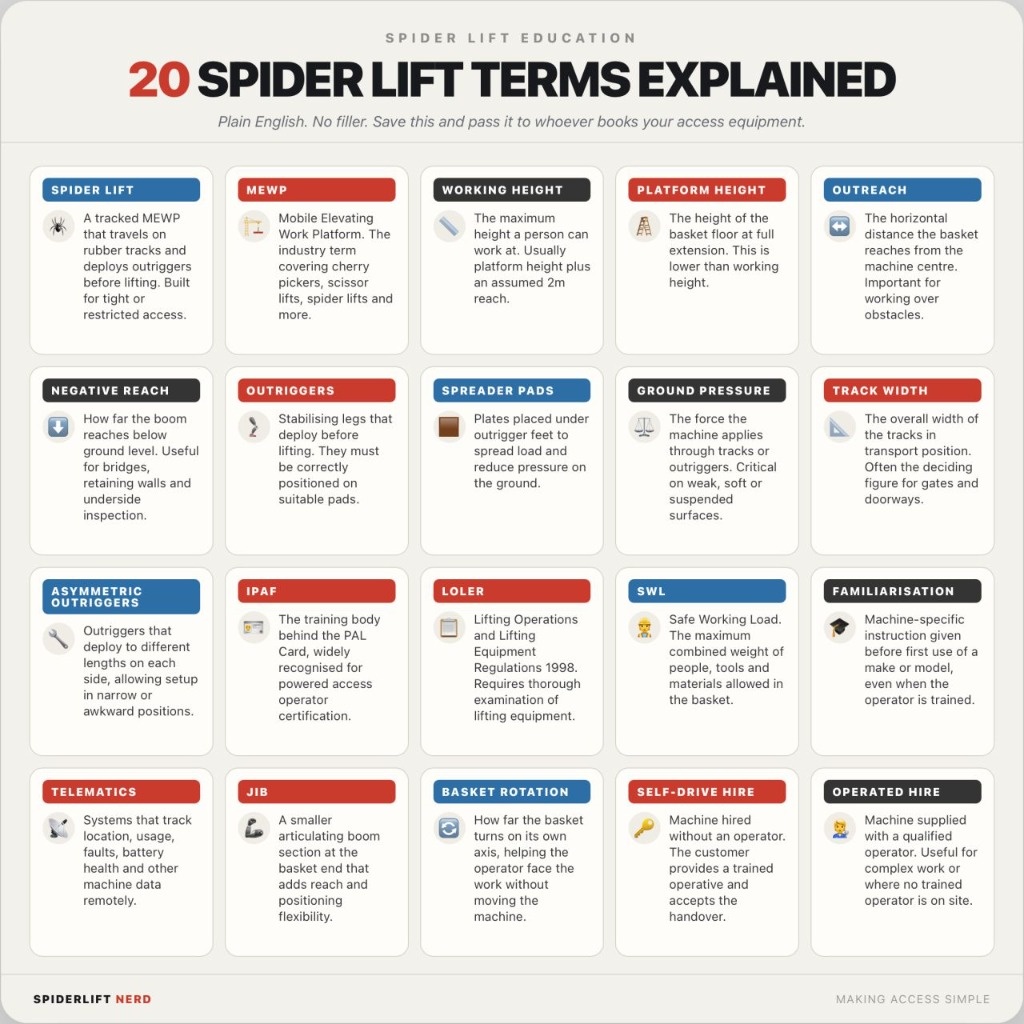
Here’s a little more detail about what each term means and why it matters.
1. Spider lift
A spider lift is a tracked mobile elevating work platform that uses outriggers for stability before the platform is raised.
The tracks help it travel through restricted or difficult access, while the outriggers create a stable working base. Many models can reduce their travelling width to pass through narrow gateways or doorways.
Spider lifts are particularly useful where conventional boom lifts or truck-mounted platforms cannot reach the working position. That doesn’t mean they’re automatically suitable for every difficult site.
2. MEWP
MEWP stands for Mobile Elevating Work Platform.
It’s the wider industry term covering equipment such as boom lifts, scissor lifts, truck mounts and spider lifts.
When somebody asks for a MEWP, the next question should be what they need it to do. The term describes a broad family of machines rather than one specific type.
3. Working height
Working height is the maximum height at which a person is expected to work from the platform.
Manufacturers usually calculate this by taking the maximum platform height and adding an assumed person’s reach—often around two metres.
It’s a useful comparison, but don’t select a machine using working height alone. Where the machine will stand and how far it must reach horizontally can be just as important.
4. Platform height
Platform height is the maximum height of the basket floor when the machine is fully elevated.
It is lower than the quoted working height because it doesn’t include the operator’s assumed reach.
If your work requires the basket floor itself to reach a particular level, platform height may be the more useful figure.
5. Outreach
Outreach describes how far the basket can reach horizontally from the machine.
It matters when the machine cannot stand directly underneath the work—for example, when reaching over a conservatory, landscaped area, production line or section of lower roofing.
Maximum outreach may change depending on basket load, outrigger configuration and working height. Always look at the machine’s complete working envelope rather than relying on one headline number.
6. Negative reach
Negative reach is the machine’s ability to work below the level on which it is standing.
This can be useful for bridge inspections, retaining walls, quaysides and other work where the target is below ground level.
Not every spider lift offers useful negative reach, so it should be checked against the actual work position.
7. Outriggers
Outriggers are the stabilising legs deployed before the platform is raised.
They transfer the machine’s loads into the supporting surface and create the stable base required for operation.
Outriggers must be positioned correctly on suitable ground. Automatic setup systems can assist with levelling, but they don’t remove the need to assess ground conditions and follow the manufacturer’s instructions.
The HSE advises that outriggers should be extended and chocked before raising the platform, with spreader plates used where necessary.
8. Spreader pads
Spreader pads are placed underneath the outrigger feet to distribute the applied load over a larger area.
They can reduce the pressure placed on the supporting surface, but simply putting a pad underneath an outrigger doesn’t automatically make the setup safe.
The required pad size depends on factors including the machine’s maximum outrigger load and the bearing capacity of the ground. Ground conditions should be properly assessed rather than guessed.
9. Ground pressure
Ground pressure describes the force a machine applies to the surface beneath it.
For spider lifts, it’s important to distinguish between the pressure applied while travelling on the tracks and the loads applied through the outriggers while the machine is working.
Soft ground, suspended floors, decorative paving, cellars, underground services and uncompacted areas can all affect whether a setup is suitable.
The HSE specifically highlights trenches, manholes, temporary covers and uncompacted backfill as potential causes of instability.
10. Track width
Track width usually refers to the overall width of the machine’s tracks in its transport configuration.
Some spider lifts have adjustable tracks that retract for narrow access and extend to provide greater stability while travelling.
Track width can determine whether a machine will pass through an entrance, but remember to check the machine’s complete dimensions. Width is no help if the machine is too tall, too long or unable to turn once it gets through.
11. Asymmetric outriggers
Asymmetric or variable outriggers can be positioned differently on each side of the machine.
This can help a spider lift set up in narrow or awkward spaces where fully extending every outrigger isn’t possible.
The available working envelope may be restricted according to the outrigger positions. The machine’s control system and manufacturer’s instructions determine what movements are permitted in each configuration.
12. IPAF
IPAF is the International Powered Access Federation.
It promotes the safe and effective use of powered access and operates recognised MEWP training programmes. Operators who successfully complete the relevant IPAF course and assessment receive a Powered Access Licence, commonly known as a PAL Card.
A PAL Card records the categories of equipment on which the holder has been trained. The category and expiry date should be checked—not merely whether somebody possesses a card.
13. LOLER
LOLER stands for the Lifting Operations and Lifting Equipment Regulations 1998.
The regulations place duties on people and organisations that own, operate or control lifting equipment used at work. They cover matters including suitability, planning, supervision and thorough examination.
A thorough examination isn’t the same as routine servicing or a daily pre-use check. For equipment used to lift people, the normal examination interval is six months unless a competent person has established a different written examination scheme.
Further guidance is available directly from the Health and Safety Executive.
14. SWL
SWL means Safe Working Load.
For a spider lift basket, this is the maximum permitted combined load of the people, tools and materials carried in the platform.
It isn’t simply the operator’s weight. Everything taken into the basket counts, and the machine’s available outreach may change according to the platform load.
Never exceed the limit stated by the manufacturer.
15. Familiarisation
Familiarisation is machine-specific instruction for somebody who is already trained but hasn’t previously used that particular make or model.
It should cover matters such as controls, safety devices, emergency lowering, operating limitations and model-specific features.
Familiarisation doesn’t replace operator training. IPAF states that operators need familiarisation before using a MEWP that is significantly different in weight, height, length or complexity from the machine on which they were trained.
More information is available in IPAF’s familiarisation guidance.
16. Telematics
Telematics systems remotely record and transmit machine information.
Depending on the system, this might include location, hours of use, battery condition, fault codes, charging information and service alerts.
For hire companies, telematics can help with maintenance planning, fleet utilisation and fault diagnosis. It doesn’t replace physical inspections or proper communication with the operator.
17. Jib
A jib is an additional articulated boom section near the basket.
It can provide extra movement and positioning flexibility, helping the operator place the basket around or above an obstacle.
Jib length and movement vary considerably between machines, so it’s worth looking beyond whether a specification sheet simply says that one is fitted.
18. Basket rotation
Basket rotation describes how far the platform can turn around its own mounting point.
It can help the operator face the work more comfortably and position the basket in restricted areas without moving the entire boom.
The available rotation differs between machines and can affect how well the basket fits into a particular work position.
19. Self-drive hire
Self-drive hire means the machine is supplied without an operator.
The customer is normally responsible for providing a suitably trained and familiarised operator, assessing the site and managing the work.
Exact responsibilities depend on the hire agreement, so they should be understood before the machine is delivered.
20. Operated hire
Operated hire means the machine is supplied with an operator.
This can be particularly useful for complex work, specialist machines or customers who don’t have a suitably trained operator available.
Supplying an operator doesn’t remove the customer’s wider responsibilities for the site, task and coordination of the work. The hire company and customer still need to exchange accurate information and agree how the job will be managed.
Which terms matter most when booking a spider lift?
You don’t need to memorise every specification in a machine brochure.
Before making an enquiry, concentrate on the information that describes the actual job:
- What working height is required?
- How much outreach is needed?
- Where can the machine stand?
- What is the narrowest point on the access route?
- Are there height restrictions, corners, slopes or steps?
- What will the machine travel over?
- What will support the outriggers?
- How much setup space is available?
- What people, tools and materials need to go in the basket?
- Is self-drive or operated hire more appropriate?
Photographs, accurate measurements and a clear description of the work are often more useful than asking for a particular model.
The best spider lift isn’t automatically the tallest, lightest or most expensive one.
It’s the machine that can access the working position, set up correctly and safely complete the task.
Download 20 Spider Lift Terms Explained
Save the PDF guide or send it to whoever books powered access for your business.
This article provides general information only. It doesn’t replace operator training, a suitable risk assessment, a site-specific plan, competent advice or the machine manufacturer’s instructions.
Matt Dean
↳ Technical Field Sales Specialist & Co-Creator of MewpHub
Matt Dean is a UK powered access specialist with 16 years of experience, specializing in spider lifts (tracked access platforms). He co-founded MewpHub and works directly with contractors, tree surgeons, and facilities managers nationally to supply operated and self-drive access solutions.